02 · Research

Technology designed around people.

Three connected research directions consider how people think, feel, move, and interact with technology. The work begins with shared immersive experiences, then develops wearable intelligence for recognising activity, supporting safety, and locating people in everyday environments. It culminates in understanding human states and designing responsive Human–AI interactions.

01

Shared realities, learning, and situated experiences

Immersive Computing

Virtual, augmented, and mixed reality support collaborative interaction, education, motor-cognitive activities, rehabilitation, and practical training.

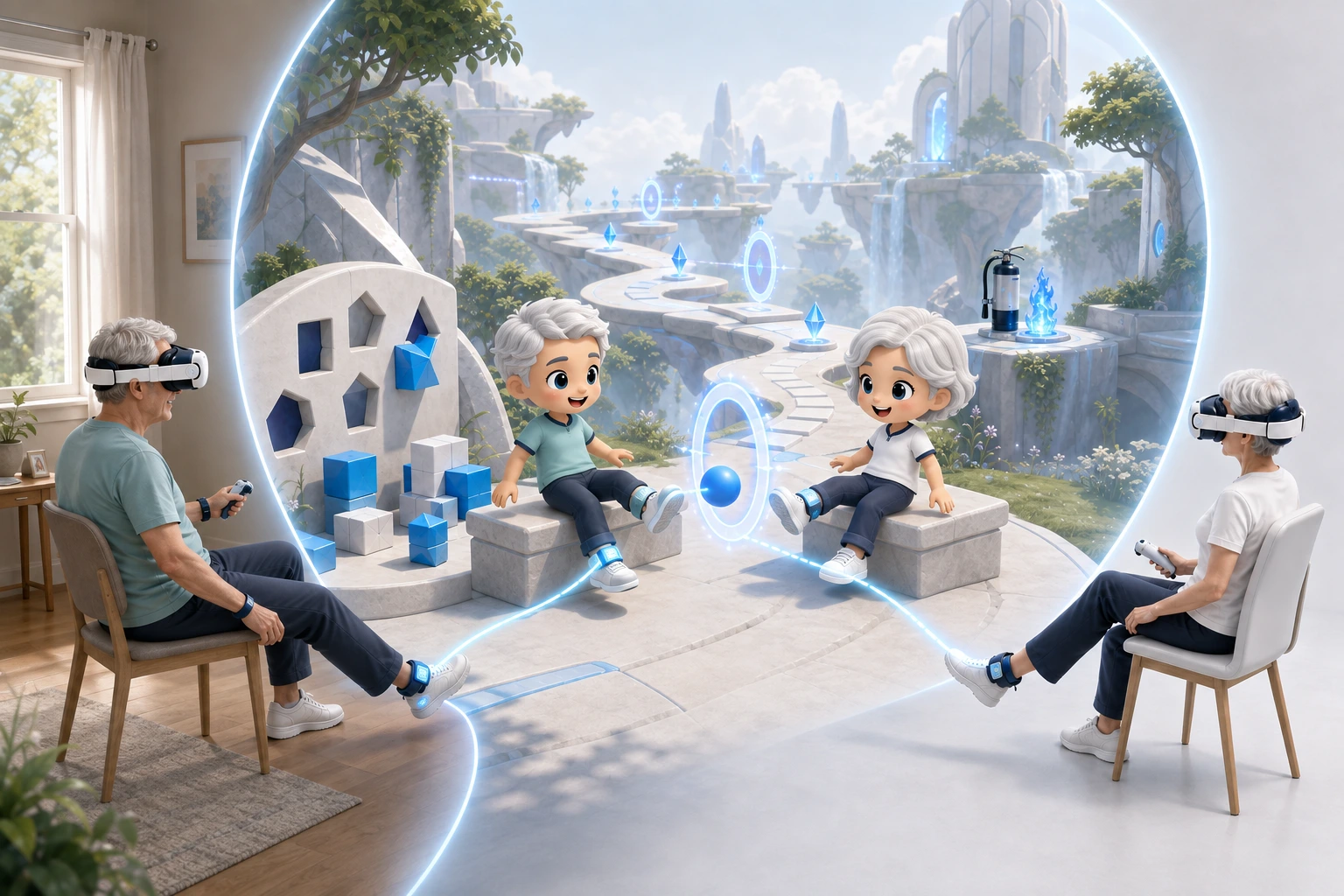
Two patients wearing VR headsets in separate physical locations, connected to cute avatars collaborating on a shared ball-and-target rehabilitation task in a virtual world with spatial puzzles and movement challenges
Collaborative

Collaborative Immersive Environments

Shared virtual and augmented reality experiences for studying social presence, engagement, relationships, and cooperative play.

Education

Immersive Education

Mixed and virtual reality puzzle activities that connect game-based learning with engagement, critical thinking, and physics education.

Motor-Cognitive

Motor-Cognitive Computing

Augmented reality Mahjong activities that combine motor actions with cognitive tasks for older adults.

Rehabilitation

Immersive Rehabilitation

Immersive rehabilitation environments with virtual peer mentors, clinician-led scenarios, and guided movement activities.

Training

Immersive Training

Serious-game environments for fire safety education, haptic practice, and procedural learning.

02

Intelligence worn close to the body

Wearable Intelligence

Wearable platforms support driver-state monitoring, firefighter safety, indoor localisation and mapping, and movement-based rehabilitation.

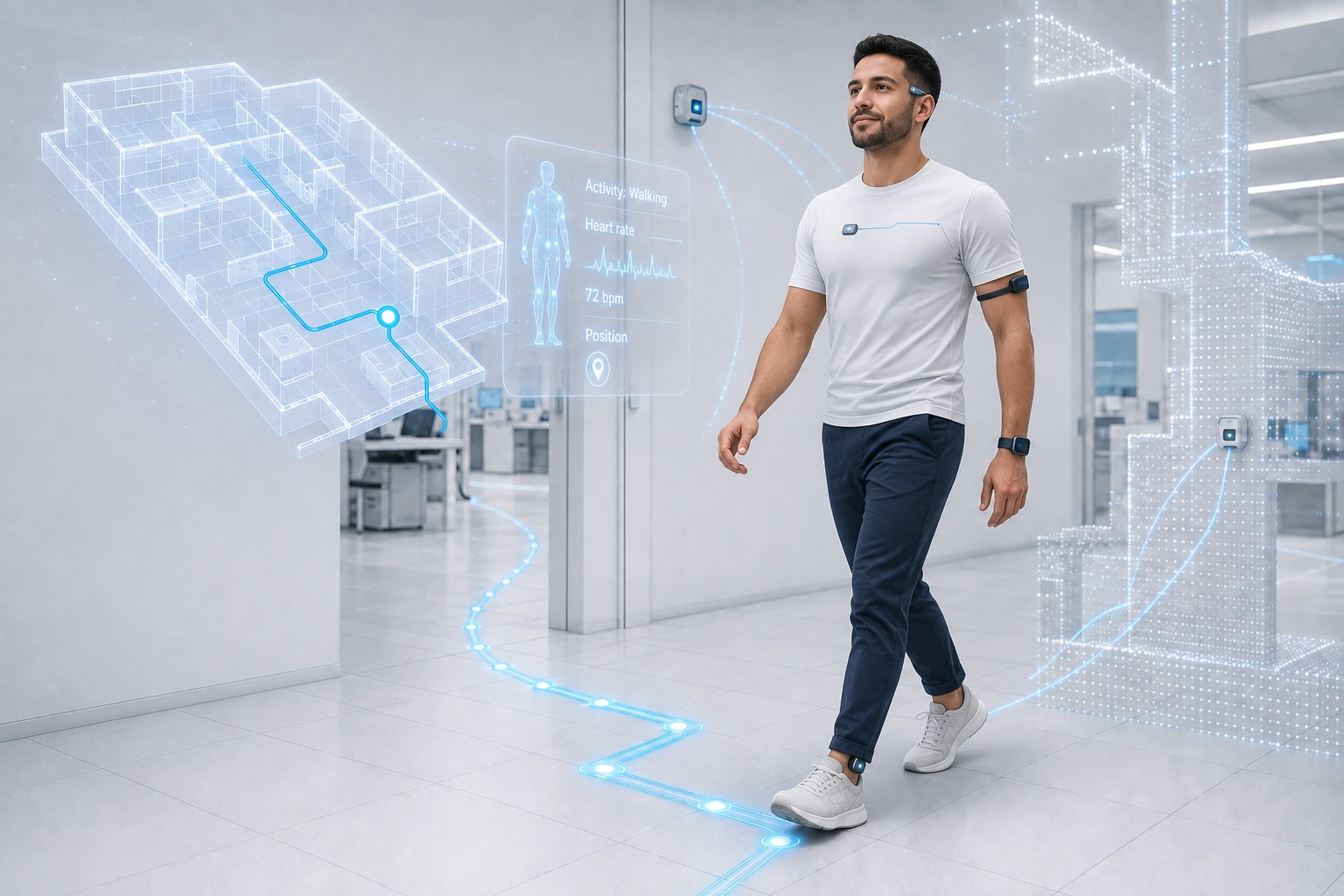
A person wearing discreet temple, chest, arm, wrist and ankle sensors in a connected indoor space, with floating room-map and personal-status holograms, a floor navigation route and point-cloud mapping
Driver

Driver State Monitoring

Behind-the-ear EEG and other wearable sensing approaches for monitoring driver alertness, fatigue, stress, and emotional responses.

Firefighting

Firefighter Activity and Safety

Multimodal wearable sensing for recognising firefighter activity, identifying falls, and supporting safety during demanding training.

Localisation and Mapping

Localisation and Mapping

Dual-foot inertial sensing, pedestrian dead reckoning, gait analysis, and wearable SLAM for indoor localisation and mapping.

Rehabilitation

Wearable Rehabilitation

Wearable movement sensing connected with virtual exercise guidance and lower-limb rehabilitation activities.

03

Human states, agents, and responsive computing

Human–AI Interaction and Intelligent Sensing

Wireless activity recognition, intelligent agents, edge computing, and human-state sensing inform responsive interactions centred on people.

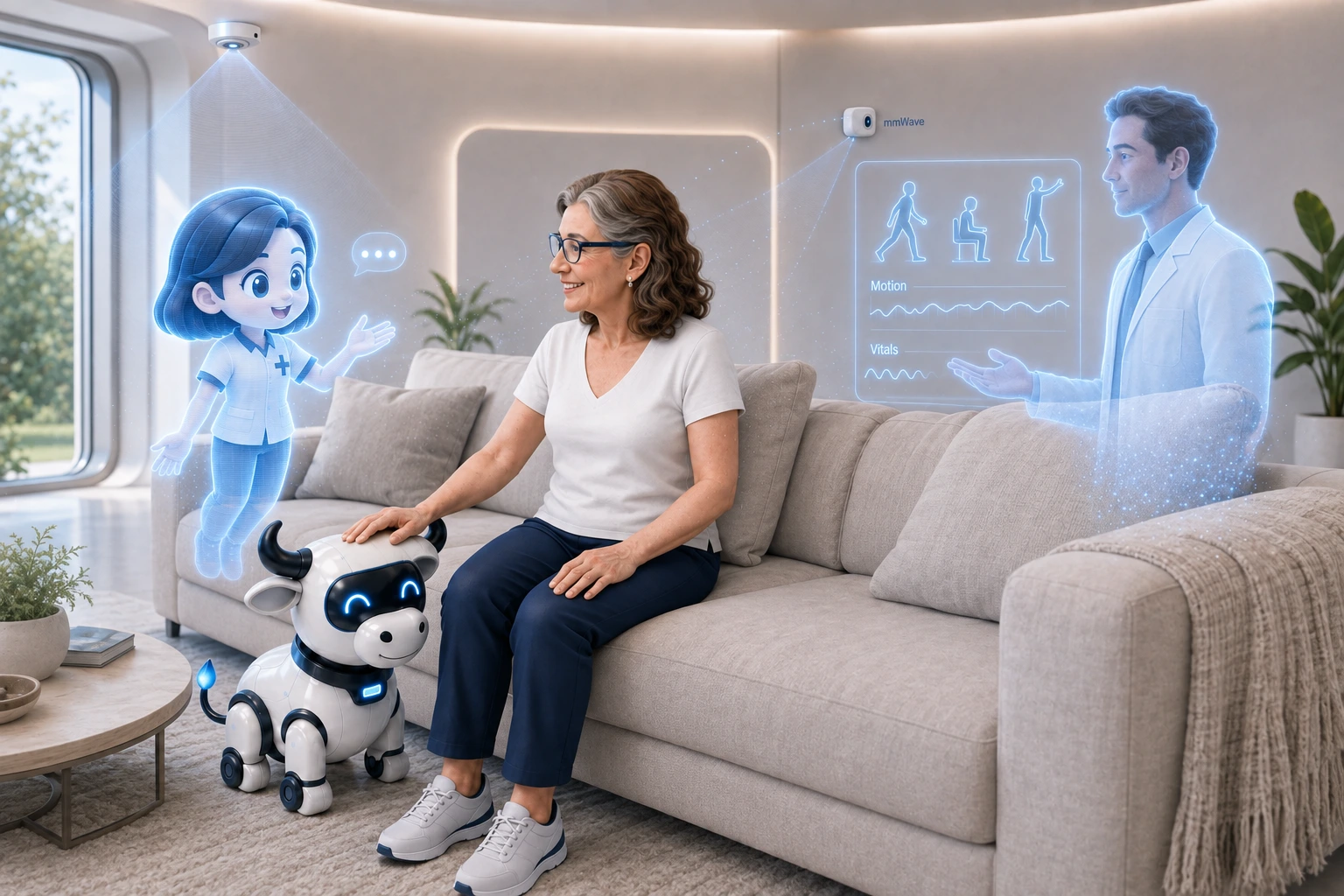
Futuristic contactless care in a furnished living room: an older adult wearing smart glasses sits on her sofa, talks with a projected virtual companion and pets a robotic ox, while a remote holographic doctor reviews motion and vital-sign estimates from room-mounted mmWave sensing
Activity Recognition

Wireless Activity Recognition

Wi-Fi sensing and domain-general activity recognition designed to interpret movement in varied indoor layouts.

Agents

Intelligent and Pedagogical Agents

Pedagogical agents, interactive avatars, and crowd-aware virtual characters studied through appearance, behaviour, social interaction, and user acceptance.

Edge Computing

Edge Computing

On-demand sensor-data processing, dynamic transfer learning, and communication approaches for resource-aware edge intelligence.

Mental and Cognitive

Mental and Cognitive Sensing

Physiological and behavioural sensing for cognitive load, emotion, driver state, and adaptive immersive experiences.

Research Projects

2026

International Conference on Intelligent Human-Machine Interaction and Ningbo International Scientific and Technological Exchange and Cooperation

2026–2027

Construction and Empirical Study of a Cardiac Rehabilitation Program for the Transitional Period of Chronic Heart Failure Based on a Large Risk Early-Warning Model

2026

New Approaches to Textbook Development in the Age of Artificial Intelligence

2026–2027

A Study on the Mechanisms and Pathways of Artificial Intelligence-Enabled Cognitive Load Reduction in EMI Teaching

2023–2025

Construction of a Multimodal-Based Risk Model for Sarcopenia in Older Adults and Intervention Research Using Extended Reality Technology

2023–2025

Smart Rescue: A Wearable Cyber-Physical System for Next-Generation First Responders Protection

2021–2024

Research on Fire Scene Dispatching Command and Remote Investigation Technology

2023–2024

A 5G-Based Smart Healthcare Service Platform for “Two Chronic” Diseases Elderly Care with 3-Levels Area-Street-Residential Coverages

2021–2025

Research on Smart Firefighting Operations System

2021–2023

Research on Embedded Wearable Sensors for Firefighters Safety Assessment and Applications

2021–2023

Research on Smart AI for Firefighter Safety Assessment

2021–2026

Artificial Intelligence Applied to Ningbo-Specific Credit Risk

2014–2019

Research on Wearable IoT-Based Driver State Estimation System

Publications

01

Journal and Conference Papers

2026

H. Tang, B. G. Lee, D. Towey, M. L. Wilson, and M. Pike, “Cognitive Style Shapes Search Behaviours: An fNIRS Study of Exploratory Search,” Proceedings of the 49th International ACM SIGIR Conference on Research and Development in Information Retrieval, 2026.

2026

P. C. Y. Cheah, B. G. Lee, D. Towey, D. Chieng, T. Y. Chen, and Z. Q. Zhou, “MRT4Depth: Metamorphic Robustness Testing for Ground-Truth-Free Evaluation of Monocular Depth Estimation Models,” IEEE Transactions on Reliability, vol. 75, pp. 2560–2574, 2026, DOI 10.1109/TR.2026.3711986 .

2026

H. Tang, Y. Zhang, A. Guerra-Manzanares, B. G. Lee, D. Towey, M. L. Wilson, et al., “The Trust Gap in Agentic Search: How Verbal-Imagery Cognitive Styles Shape Behavioural Signals and AI Acceptance,” 2026 IEEE 50th Annual Computers, Software, and Applications Conference, 2026.

2026

P. C. Y. Cheah, B. G. Lee, and Y. Yang, “Minority Sample Selection in Fraud Detection with Classifier-Based Reinforcement Learning,” The Computer Journal, vol. 69, no. 6, pp. 1069–1079, 2026.

2026

L. Zheng, S. Ke, Y. Zhang, L. Sun, M. Pike, and B. G. Lee, “Context-Dependent Roles of Familiarity, Discipline, and Personality in Shaping Social Engagement in Cooperative Immersive Learning,” Computers in Human Behavior Reports, vol. 22, 2026, DOI 10.1016/j.chbr.2026.101089 .

2026

Y. Yang, Z. Su, Y. Zhang, C. C. Goh, Y. Lin, A. G. Bellotti, and B. G. Lee, “Kolmogorov–Arnold Networks-Based GRU and LSTM for Loan Default Early Prediction,” Applied Soft Computing, vol. 197, 2026, DOI 10.1016/j.asoc.2026.115213 .

2026

R. Han, B. G. Lee, D. Towey, Y. Yao, and M. Pike, “A Virtual Peer Mentor to Enhance Social Presence in VR Rehabilitation for Recovering Heart-Attack Patients,” IEEE Transactions on Visualization and Computer Graphics, vol. 32, no. 5, pp. 3809–3819, May 2026, DOI 10.1109/TVCG.2026.3679134 .

2026

Y. Zuo and B. G. Lee, “MAHJONG: An Augmented Reality Rehabilitation Serious Game for Motor-Cognitive Dual-Task Training in Older Adults,” 2026 IEEE Conference on Virtual Reality and 3D User Interfaces Abstracts and Workshops, pp. 1049–1050, 2026, DOI 10.1109/VRW70859.2026.00199 .

2026

L. Zheng, G. Cheng, S. Ke, J. Yuan, Y. Fan, B. G. Lee, and M. Pike, “Differential Effects of Virtual and Augmented Reality on Social Presence and Engagement in Collaborative Gaming for Unfamiliar Users,” 2026 IEEE Conference on Virtual Reality and 3D User Interfaces, pp. 420–430, 2026, DOI 10.1109/VR67842.2026.00063 .

2026

B. G. Lee, “Sensors Fusion in Digital Healthcare Applications,” Sensors, vol. 26, no. 6, article 1870, 2026.

2025

Y. Yang, Y. Lin, Y. Zhang, Z. Su, C. C. Goh, T. Fang, A. Bellotti, and B. G. Lee, “Transforming Credit Risk Analysis: A Time-Series-Driven ResE-BiLSTM Framework for Post-Loan Default Detection,” Information, vol. 17, no. 1, article 5, 2025.

2025

L. Nkenyereye, B. G. Lee, and W. Y. Chung, “Deep Q-Learning with Feature Extraction and Prioritized Experience Replay for Edge Node Overload in Edge Computing,” Engineering Applications of Artificial Intelligence, vol. 162, article 112124, 2025, DOI 10.1016/j.engappai.2025.112124 .

2025

S. H. Kalan, B. G. Lee, and W. Y. Chung, “CNN-LiDAR-SLAM: Multimodal Fusion With Object Detection for Indoor Localization,” IEEE Access, vol. 13, pp. 198864–198877, 2025.

2025

Y. Li, D. Chieng, B. G. Lee, C. F. Kwong, K. M. Lim, and S. Li, “Wi-ViTAL: Domain Generalization of Wireless Human Activity Recognition Using Linear Attention Vision Transformer With Adversarial Learning,” IEEE Transactions on Mobile Computing, 2025.

2025

J. Zhou, D. Chieng, B. G. Lee, J. Ji, Z. Liu, and J. Li, “Supervised Momentum Contrastive Learning-Based Coarse-to-Fine Fusion Path Planning,” IEEE Transactions on Automation Science and Engineering, vol. 22, pp. 23909–23922, 2025, DOI 10.1109/TASE.2025.3626557 .

2025

Y. Yu, C. Xu, S. Yang, Y. Cao, Y. Wang, and B. G. Lee, “VRtalk: Real-Time Interactive Intelligent Anime Avatars in Virtual Reality,” 2025 IEEE International Symposium on Mixed and Augmented Reality, pp. 1191–1201, 2025, DOI 10.1109/ISMAR67309.2025.00125 .

2025

L. Zheng, G. Cheng, S. Ke, J. Yuan, B. G. Lee, and M. Pike, “Understanding Asymmetric Collaboration in Augmented and Virtual Reality Immersive Environments,” Adjunct Proceedings of the 38th Annual ACM Symposium on User Interface Software and Technology, 2025, DOI 10.1145/3746058.3758399 .

2025

X. Chai, J. Yu, B. G. Lee, M. Pike, L. Nkenyereye, and W. Y. Chung, “A Multimodal Decision-Fusion Network Approach for Activity Recognition in Firefighter Self-Contained Breathing Apparatus Endurance Training,” IEEE Sensors Letters, 2025.

2025

R. Han, B. G. Lee, M. Pike, D. Towey, Y. Yao, Y. Wang, and W. Y. Chung, “SPROUTFIT: An Immersive Seed-Planting Virtual Reality Game to Enhance Patient Motivation for Performing Exercises for the Prevention of Venous Thromboembolism through Loss and Avoidance Gamification,” Virtual Reality, vol. 29, no. 3, article 137, 2025, DOI 10.1007/s10055-025-01220-2 .

2025

D. Spina, J. Gwizdka, K. Ji, Y. Moshfeghi, J. Mostafa, T. Ruotsalo, M. Zhang, et al., “Report on the 3rd Workshop on NeuroPhysiological Approaches for Interactive Information Retrieval (NeuroPhysIIR 2025) at SIGIR CHIIR 2025,” ACM SIGIR Forum, vol. 59, no. 1, pp. 1–43, 2025.
02

Patents

2026

Infrared Image Generation Method, Apparatus, Device, and Storage Medium, ZL202310496326.7, CN116503494B, February 2026.

2026

Method, Apparatus and System for Motion Tracking, US12523474B2, January 2026, Patent record

2025

Firefighting Information Display Method, Apparatus, Device, and Storage Medium, ZL202210763849.9, CN115080655B, August 2025.

2025

Wearable Device for Firefighter Motion and Physiological Monitoring, ZL202430697423.8.9, CN309357423S, June 2025.

2025

Ultrasonic Wave-based Indoor Inertial Navigation Mapping Method and System, US12467767B2, 2025, Patent record

2024

Temperature Measurement Device Based on Thermal Imaging, ZL202420128844.3, CN221445299U, July 30, 2024.

2024

Method, Device, and System for Determining Motion Trajectories, ZL202210112970.3, CN114485647B, July 19, 2024.

2024

Fusion Method for Visible Light and Infrared Images Based on Focus Loss Function Constraint, ZL202311386447.3, CN117115065B, January 23, 2024.

2023

Indoor Inertial Navigation Mapping Method and System Based on Ultrasonic Technology, ZL202210220368.3, CN114577206B, October 31, 2023.

2023

New Type of Thermal Imaging Surveillance Camera, ZL202322232652.5, CN220528134U, August 18, 2023.

2023

New Type of Infrared Thermal Imaging Glasses, ZL202321001495.0, CN219590611U, April 28, 2023.

2022

Parking Space Positioning Device, ZL202222786323.0, CN218375631U, October 21, 2022.

2022

Shoes with Positioning Function, ZL202220787783.2, CN217161226U, April 6, 2022.

2022

Wearable Device for Fall Detection, ZL202220783649.5, CN218684386U, April 6, 2022.

2022

Communication Rope and Emergency Rescue System, ZL202220454968.1, CN218976684U, March 3, 2022.

2019

Intelligent Device for Motion Recognition and Its Control Method, South Korea Patent, 10-2057705, December 13, 2019.

2019

Wearable Device for Motion Recognition and Control, and Its Motion Recognition Control Method, South Korea Patent, 10-1963694, March 25, 2019.

03

Software Copyright

2022

Multifunctional Portable Fire Command Auxiliary System, 2022SR1354561, April 12, 2022.

2021

Firefighter Safety Detection System Software, 2022SR0363015, December 23, 2021.